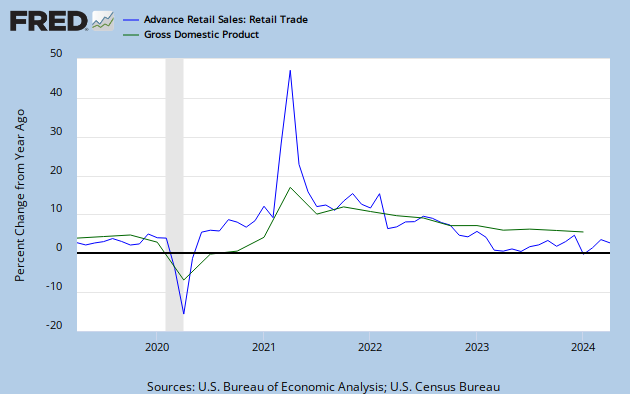
One thing to keep in mind is that retail sales is only measured in nominal terms, which means that no adjustment is made for inflation. This makes it difficult to tell whether a jump in the numbers came from consumers actually purchasing more or paying more to cover higher prices charged by retailers. Also the initial retail sales releases tend to be extremely volatile and thus misleading. This is partially because the advanced estimates are based on a relatively small sampling size. A three month moving average of the data provides a more accurate picture of whats occurring in the economy. For a look at the percentage changes go to table 2A which shows that retail sales dropped 1.4% in May but is still up 7.4% from last May. If you exclude motor vehicle sales and auto-related products (which tend to be extremely volatile) we see that the fall in the retail sales numbers is by a smaller 1.1% which (according to this number) is still up 6.1% from last May. So what exactly are U.S. consumers purchasing? Apparently gasoline which is up in usage 20.2% since last May (although this increase may represent an rise in gasoline prices). Furthermore, we see that the end of the April 30th homebuyer tax-credit brought about a drop in demand for building materials( -9.3% drop from last month). Overall the report is generally a disappointment among the economics community (check out WSJ's Economists React: 'Weaker Underlying Picture Revealed' for Consumer) as it suggests we have a struggling consumer. The Census Bureau should track polo hat sales: If demand for ridiculous items picks up then the "true American consumer" will be perched back up on their throne.
Friday, June 11, 2010
A look at the Advanced Retail Sales Numbers
One thing to keep in mind is that retail sales is only measured in nominal terms, which means that no adjustment is made for inflation. This makes it difficult to tell whether a jump in the numbers came from consumers actually purchasing more or paying more to cover higher prices charged by retailers. Also the initial retail sales releases tend to be extremely volatile and thus misleading. This is partially because the advanced estimates are based on a relatively small sampling size. A three month moving average of the data provides a more accurate picture of whats occurring in the economy. For a look at the percentage changes go to table 2A which shows that retail sales dropped 1.4% in May but is still up 7.4% from last May. If you exclude motor vehicle sales and auto-related products (which tend to be extremely volatile) we see that the fall in the retail sales numbers is by a smaller 1.1% which (according to this number) is still up 6.1% from last May. So what exactly are U.S. consumers purchasing? Apparently gasoline which is up in usage 20.2% since last May (although this increase may represent an rise in gasoline prices). Furthermore, we see that the end of the April 30th homebuyer tax-credit brought about a drop in demand for building materials( -9.3% drop from last month). Overall the report is generally a disappointment among the economics community (check out WSJ's Economists React: 'Weaker Underlying Picture Revealed' for Consumer) as it suggests we have a struggling consumer. The Census Bureau should track polo hat sales: If demand for ridiculous items picks up then the "true American consumer" will be perched back up on their throne.
Wednesday, June 9, 2010
Why I Keep The Beige Book Under My Pillow. . .
Home sales and construction picked up till the end of the Home Buyers Tax Credit which expired on April 30th, and coincidentally in May these areas have been reported as slowing. Lower rents have pointed as a reason for increasing leasing activity in New York, Philadelphia, Richmond, Kansas City, Dallas, and San Francisco. One noteworthy extract is that some districts cited concerns over the potential impact of the European fiscal crises on financial and business conditions. These districts reported a corresponding increase in uncertainty and financial market volatility.
A look at Cleveland's report (since Cincinnati is a local branch) reveals that demand by business for new loans remains weak sauce. However, some bankers commented that the lending environment is starting to grow more competitive. This is generally consistent with yesterdays release of the Small Business Optimism Index . On a positive note, a large majority of the contacts reported that inventories are now well balanced which reflects increased demand. Furthermore, the number of respondents who plan on additional spending during the second half of 2010 has increased "substantially" since the last report.
For some Gulf oil spill action, the Atlanta Feds district said that contacts indicated the potential impact on the tourism industry along the coast line of Louisiana, Mississippi, Alabama, and western Florida could be substantial:
"In some cases, vacation lodging cancellations have been replaced by bookings for clean up crews, laborers, and the National Guard."
Tuesday, June 8, 2010
Index of Small Business Optimism and the Aggregate Demand Dilemma
"Since the third quarter of 2009, job creation plans have seriously underperformed the recoveries from the other two deep recessions covered by the NFIB survey. Coming out of the milder 1991 recession, construction added more than 100,000 jobs and 20,000 new firms in a year's time."Credit conditions are of special interest in the report and point to very slow improvement. A net 13 percent of NFIB members reported loans harder to get than in their last attempt, which is down one point from April. The main reason for small businesses owners not hiring or expanding their business is because of the lack in aggregate demand as ninety-two percent of the owners reported all their credit needs met, or they did not want to borrow.
"Very weak plans to make capital expenditures, to add to inventory and to expand operations make it clear that many good borrowers are simply on the sidelines, waiting for a good reason to make capital outlays and order inventory and take out the usual loans used to support these activities."The report makes the claim that what businesses need are customers, giving them a reason to hire and make capital expenditures and borrow to support those activities. Indeed, thirty percent cited weak sales as their top business problem, which is up one point from April.
Sunday, June 6, 2010
Is the Double-Dip Inevitable?
"the federal stimulus (of which 75 percent has been spent), near-zero interest rates (which can’t continue much longer without igniting speculative bubbles), and replacements (consumers have had to replace worn-out cars and appliances, and businesses had to replace worn-down inventories)."Another bad sign is that some of the insiders like the super-rich believe that a double-dip will indeed occur. Robert Frank of WSJ's Wealth Report, wrote that the super rich were buying gold again and how troubling that is. For additional support he points to a survey of the rich and super rich which found that 25% of those with a net worth of $15 million or more believed the global economy will deteriorate in the next five years, compared with an average of 17% of respondents with $1.5 million or more. His theory (and i tend to agree with him on all three points) is that:
"First, the wealthy have better information than most Americans, and that information suggests more bad news to come.Second, the wealthy have more to lose (in pure dollar terms) than the nonwealthy. The risks of losing a fortune right now appear greater than the potential for building a fortune.
Third (and related to the second theory) the wealthy are making conservative bets with their money, avoiding bold trades and preferring to sit on cash. People who hang on their cash to preserve their fortunes are by nature going to be more cautious about the broader economy."
It will be interesting to see if all these rumors will become a self-fulfilling process as the economy's state is all of a sudden highly questionable. Macro Man is skeptical of the markets and economies ability to recover because the negatives seem to be overwhelmingly outweighing any positives, for example pointing to the recovery in manufacturing and how it's unlikely to be the miracle we're looking for. Macro Man is worried about all the problems in Europe becoming even worse as they brace themselves for epic disaster:
"In spite of the authorities the world over seemingly having thrown everything, including the kitchen sink at the problem, the market seems to have gone back to square one in the past couple of days. The panic in the EUR periphery not only continues unabated, but is now spreading to “soft-core” countries (Austria, Belgium, Finland) and France (welcome to the Club Med, Mr. Sarkozy)."
Saturday, June 5, 2010
The Employment Situation and the Double Dip
Initial unemployment insurance claims have been steadily falling since its peak in early 2009, but has seemed to level off around 460,000 which indicates that the economy is still weak and in danger of slipping back into contraction (possibly a double dip). A general rule of thumb is that when first-time claims stand above 400,000 for several weeks the economy may be in danger of slipping into a recession. A number below 400,000 suggests a recovery in underway and companies are laying off fewer workers.
The above graph shows the two recessions of the early 1980's where initial unemployment claims originally leveled off slightly above 400,000 before the economy slipped into another contraction. I have a feeling that maybe the same thing will happen in the most recent scenario given that the economy is still in a very fragile state.