Showing posts with label Home Buyers Tax Credit. Show all posts

Wednesday, June 16, 2010

Housing Starts Data: Not A Surprise

For X.U. Economics blog readers the drop in housing starts does not come as a surprise but is still discouraging.  Yesterday we looked at the Housing Market Index which warned us that this would happen.  Housing Starts and Building Permits data essentially just records the number of new homes being built and permits being issued for future construction.

When browsing over the data it is important to note the performance of "single-family housing start" as opposed to "multi-family starts." This is because single-family home building is based on consumer confidence and demand, while construction for multi-unit apartments can be subject to speculation and changes in the tax code.  The most recent release indicates only 468,000 single-family housing starts in May as compared to the slight pick-up of 565,000 found in April's release ( Current New Residential Construction Press Release).

 One possible explanation is the disappearance of the home-buyers tax credit and with it a vanishing act by demand.  Another reasonable explanation is that growing families are looking to rent as opposed to purchasing a new home- especially with job stability being a hard thing to count on.  Whatever the reason may be the drop in single family housing starts is not a good sign for those betting on a V-shaped recovery.
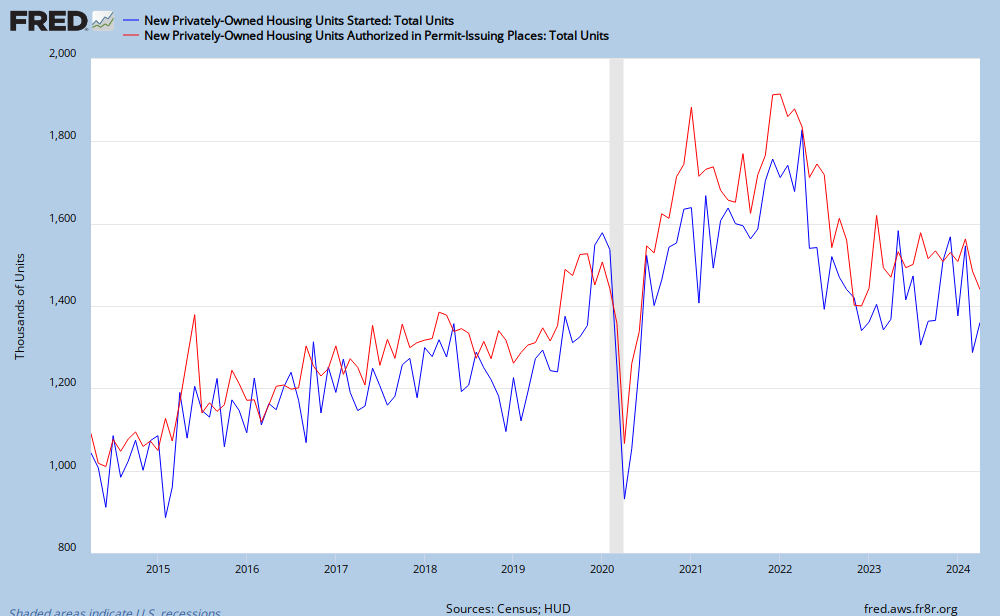

A look at Building Permits:
We have to keep close tabs on building permits because they are the precursor to housing starts.  Although the issuance of a housing permit does not necessarily result in new construction, as you can see the two series do move together over time. 
For other reactions to the housing start data.

Wednesday, June 9, 2010

Why I Keep The Beige Book Under My Pillow. . .

It gives me vivid dreams of whats to come in the economy and I like that, also it matches the color of my pillow case. The Beige Book is a summation of the 12 regional Federal Reserve Banks on whats currently occurring. It's a snapshot of the economy which is released 8 times a year, generally two weeks before the Fed's FOMC meetings. If you want to have some sort of a clue as to what the Fed will recommend at the next FOMC meeting then read the Beige Book and the Fed's speeches. The Beige Book is based on interviews with local business people and academics from each of the 12 regions. A look inside this report (The WSJ econ blog has its own tidbits here) reveals that economic activity has continued to improve but growth is at a "modest" pace.

Home sales and construction picked up till the end of the Home Buyers Tax Credit which expired on April 30th, and coincidentally in May these areas have been reported as slowing. Lower rents have pointed as a reason for increasing leasing activity in New York, Philadelphia, Richmond, Kansas City, Dallas, and San Francisco. One noteworthy extract is that some districts cited concerns over the potential impact of the European fiscal crises on financial and business conditions. These districts reported a corresponding increase in uncertainty and financial market volatility.

A look at Cleveland's report (since Cincinnati is a local branch) reveals that demand by business for new loans remains weak sauce. However, some bankers commented that the lending environment is starting to grow more competitive. This is generally consistent with yesterdays release of the Small Business Optimism Index . On a positive note, a large majority of the contacts reported that inventories are now well balanced which reflects increased demand. Furthermore, the number of respondents who plan on additional spending during the second half of 2010 has increased "substantially" since the last report.

For some Gulf oil spill action, the Atlanta Feds district said that contacts indicated the potential impact on the tourism industry along the coast line of Louisiana, Mississippi, Alabama, and western Florida could be substantial:
"In some cases, vacation lodging cancellations have been replaced by bookings for clean up crews, laborers, and the National Guard."