Showing posts with label Labor Market. Show all posts

Wednesday, April 27, 2011

Job Search Part 5: It's Policy Time!

This is the last post of this special mini-series on the job search and matching theory of unemployment. I will probably be extremely distracted for the next few months, including a month-long vacation in Europe to shake the horrors of undergrad off me. I am pleased to have provided the world with my take and interpretation of this theory, please feel free to comment if you have any suggestions.  I can be reached at stevensabol@me.com for general economics help and discussion.  Cheers!


Labor market policies meet their objectives only to the extent to how they accurately account for how individuals make their decisions about leisure and work, job search, and seizing opportunities for training and education.  These models are predominantly built around the classic neoclassical assumptions that people are perfectly rational, time consistent and entirely self-interested.  Recent research from the behavioral economics is providing more realistic and empirically centered findings about human behavior.  This research has found that people can be put off by complexity, they procrastinate and that they hold non-standard preferences and beliefs.  To the extent that these are relevant in labor markets, they change our understanding of what polices and how policies should be designed to meet their set objectives.


In what follows we will look at the following three labor market policies that are relevant to boosting employment within the model we have just explored:
1). The first involves unemployment compensation and its effect on job search intensity.  One solution to the negative effects on job search intensity caused by unemployment benefits is the inclusion of some sort of wage-loss insurance. Wage-loss insurance assists individuals with the psychological adjustment that comes with changing labor market conditions and helps mitigate likely biases in wage expectations that more than likely deter work incentives.
2). The second is with respect to employment services and job search assistance. These programs help to match employers with employees and thus improve matching efficiency. It is argued that these should be expanded to provide accessible and meaningful information about labor market conditions and occupational projections.  These should help address procrastination in job search and provide help to the unemployed and low wage individuals in a way that both reflects and takes advantage of the way people process information.
3). When dealing with mismatch (as we have discussed) job training is essential to moving workers from dying industries to thriving ones.  It is suggested that these job training programs should simplify take-up, navigation and completion and provide user-friendly information of the quality of training providers.  These should also structure choices to reflect limited abilities of individuals to manage complexity and exert self-control.


Unemployment Benefits


Unemployment compensation policies are essential for sustaining consumption over the business cycle by helping the unemployed to survive without completely relying on there savings habits (people in the United States generally have pretty poor saving habits). The problem as stated earlier is the tendency of these benefits to distort incentives to search for and take new employment. Increases in the generosity of benefits, either through increases in benefit levels or the duration of benefits, seem to lengthen the unemployment spells of those receiving unemployment insurance. Individuals return to work when they receive a job offer that pays more than their reservation wage.


Reservation Wage: The wage w^r is called the reservation wage and represents the lowest wage offer that an unemployed worker will accept.


One thing that behavioral economics tells us is that individuals have imperfect self-control which are expressed by time-inconsistent preferences. As a direct consequence, workers may procrastinate in their job search efforts even when such delay goes against their own long-run self interest. The unemployed may be hesitant to consider and slow to accept even quite reasonable job offers.  Individuals holding out for offers that will never come remain on unemployment insurance for inefficiently long periods.  One reasonable possibility is that individuals will set their reservation wage at the level they have received in the past, but this may prove to be a severe upward bias in their wage expectations given current labor demand conditions. Additionally, individuals might be loss averse in the sense of having preferences that rely on previous wages with a potentially large demoralizing psychological cost of taking a job paying below their previous earnings. Restated another way, people would rather not take a job that paid below what they think they're worth (because it may seem degrading or "beneath" them) than take a job and at least have some working income.
Loss aversion: An individuals tendency to strongly prefer losses to acquiring gains.
These effects lead individuals to be reluctant when accepting job offers below their previous wage, to be unwilling to move or relocate to areas with greater job opportunities and to search for jobs mainly just like the one they just got fired from or even to pass up reasonable opportunities while waiting for their old job (or a very similar one) to return. This observation is sometimes referred to as "retrospective wait unemployment" and is particularly important for long-termed unemployed workers displaced from high wage sectors in decline (like the automobile and steel industries). It is reinforced by the social status and personal identities of many workers strongly tied to their former jobs, after all it is what they are good at and comfortable with. Wage-loss insurance is one promising policy which may help to address these issues.
Wage-loss Insurance

Wage-loss insurance (also called wage insurance) is a policy which temporarily subsidizes worker earnings upon reemployment when the wage they receive on their new job is less than that of their old job. It lowers the reservation wage of the individual receiving unemployment insurance thus leading to shorter durations of unemployment. By manipulating the realized value of wages and making job offers more attractive, it takes care of some of that psychological fear that most workers have about making less than before.  In the longer run, it may even smooth the painful but sometimes necessary process of psychological adjustment to a lower wage employment. In making job offers more appealing, a wage-loss insurance program would effectively lower wage expectations and mitigate the effect of loss aversion. By taking away the social stigma of accepting a lower wage wage-loss insurance encourages the search effort of the unemployed and increases the job acceptance rate of those receiving unemployment benefits.  

Employment Services and Job Search Assistance

One major goal of labor market policies is to help searching individuals find a job. These policies therefore effect the efficiency with which job matches occur and directly impact our matching function. There are currently a handful of interconnected programs that enhance the returns from job search and these include informational services as well as actual job search help. The Employment Service provides placement assistance to both workers and employers, maintains labor exchange listing, and performs outreach to employers. The Workforce Investment Act (WIA) provides both counseling and assistance for job seekers.  Workers obtain access to these services through multiple channels, the most important of which are referrals  from workers taping into the Unemployment Insurance (UI)  program. The goal of these programs is to help individuals return to work quickly and even help improve the quality of matches between workers and jobs.
            Searching for work is a strenuous and complicated process. Behavioral economics stresses that individuals are limited in the attention and computational capacity they can bring to multifaceted problems. In fact, the speed and quality of employment matches may suffer due to the less than perfect ability of individuals to manage the complex tasks of job search. Looking for work is a substantial information problem. Workers have to understand labor market conditions, have knowledge of openings and application processes, posses an accurate understanding of their own still sets and how firms and markets may value those skills. Additionally, searching for work requires willpower, which can be difficult for people with zero will power (we call these people unmotivated). Workers, more likely than not, will be tempted to procrastinate in their job search in favor of other activities, like watching AMC and making daily trips to United Dairy Farmers convenience stores. Properly designed job search assistance programs can help deal with these issues. 

Policy Options

Increase Enrollment

Employment services and job search programs generally work well. So one idea is to increase the amount of people using these resources and maybe even mandating that those on unemployment insurance must enroll into one of these programs. This would certainly help individuals to overcome the desire to procrastinate. There is even evidence that the threat of enrolling someone into a job search program will cause them to accept a job much sooner than they would have otherwise.  

Simplify and Streamline the Experience

Simplifying and streamlining the experience should help individuals with managing the complexity found in the job search process. Employment and job search assistance tools should be widely available and easy to use, both physically with One-Stop Career Centers (the Walmart for job search) and online.

Job Training

 As we have seen one of the causes for outward shifts in the Beveridge curve are when employees skills become obsolete. One vital set of labor market policies, alleviates this impact as they are aimed at providing workers with the skills they need to take advantage of career opportunities. The current workhorse of these U.S. public-sector job training efforts is the Workforce Investment Act (WIA). The WIA offers occupational skills training and on-the-job training programs to both dislocated and disadvantaged workers. Services are delivered through One-Stop Career Centers and funds are made available in Individual Training Accounts (ITAs). Other major supports for job training include Pell Grants, which low-income workers can use to fund educational programs that lead to a certificate or degree, and the Lifetime Learning Credit, which is a nonrefundable tax credit available to offset educational expenses.
 Overall the results of these programs are found to be disappointing. Although the labor market returns to education are well established, programs that support job training for mid-career individuals have a mixed-record. For women the returns through improved earnings are significant, but men have seen little improvement in earnings.
 Behavioral economics suggests that the unsatisfying results of some job training programs may be due in part to a failure of such programs to respond accurately to the psychology of workers who could benefit from training. Results from behavioral economics suggest that the determination and whether to undertake job training, the selection of a field to be trained in as well as a provider, and the pursuit and completion of that training, represents an inherently challenging sequence of choices and actions for imperfect individuals.  Individuals often fail to choose optimally under stress and have difficulty exerting self-control in starting up and persisting in investment activities with distant payoffs. People are inherently short-sighted. Therefore, a successful job training program is one that reduces complexity and the need for willpower. 
 Current job training programs focus on administrative efficiency rather than end user experience. As a result, these programs are complicated to use and access. Furthermore, there has been a push from publicly  providing job training to providing individuals access to funding to pursue their own choice of training. This policy may put too much responsibility in the workers hands, as they may be ill equipped to manage all of the tasks involved. There is a very strong possibility that the very individuals who might benefit most from the training may have the most difficulty in obtaining it.   

Policy Proposal: Simplify

 Following from the above observations- an explicit goal of the WIA program should be to provide job training services in a streamlined and user friendly fashion. Job training programs should be user friendly not administrative friendly. These job training programs should take steps to reduce the barriers to entry that are so currently prevalent. At the very least they should ensure that the requirements are not more onerous for those that need it the most.  
 Training programs provided through One-Stop Career Centers should emphasize reducing complexity and providing guidance to participants as priorities. Additionally, access to Pell grants should be simplified and programs should be integrated. For example Pell recipients enrolled at a community college should receive services through the associated One-Stop Career Center. The One-Stop system is deemed by many to be the right model on which to build, but regardless policy should reflect an emphasis on the user friendliness from the participant perspective.


This section is based on work done by Babcock, Congdon, Katz, and Mullainathan (2010)

Well, this post wraps up my special mini-series on the modern job search and matching theory of unemployment.  If you would like more information please refer to the paper from which all of this is the basis of. This will probably be my last post for a while, thank you.

Listed below are all of the references for this special mini-series:

Andolfatto, David. "Interpreting the Beveridge Curve" From the blog: MacroMania
December 18, 2010. http://andolfatto.blogspot.com

Babcock, Linda, William J. Congdo, Lawrence F. Katz and Sendhil Mullainatha. "Notes on Behavioral Economics and Labor Market Policy" December 2010

Barnichon, Regis and Andrew Figura "What drives movements in the unemployment rate?  A decomposition of the Beveridge curve"Finance and Economics Discussion Series. 20 February 2011.

Beveridge, William. 1944. Full Employment in a Free Society. London: George Allen
and Unwin.

Bleakley, Hoyt and Jeffrey C. Fuhrer. "Shifts in the Beveridge Curve, Job Matching, and Labor Market Dynamics." New England Economic Review. Sept/Oct. 1997.

Bowden, R. 1980. On the existence and secular stability of the u-v loci. Economica 47, 35–50.

Clark, Kelly A. and Rosemary Hyson, "New tools for labor market analysis: JOLTS". Bureau of Labor Statistics, Monthly Labor Review December 2001.

Daly, Mary, Bart Hobijn and Joyce Kwok, “Jobless Recovery Redux?”FRBSF Economic Letter; Number 2009-18, June 5,2009

DiCecio, Riccardo and Charles S. Gascon, “Vacancies and Unemployment,” Federal Reserve Bank of St. Louis. Economic Synopses ; 2009.  Number 44.

Dow, J. and Dicks Mireaux, L. 1958. The excess demand for labour. a study of
conditions in Great Britain, 1946–56. Oxford Economic Papers 10, 1–33.

Fitzgerald, Terry J. "An Introduction to the Search Theory of Unemployment".  Federal Reserve Bank of Cleveland: 2008.

Hall, R. E. ,"The Beveridge Curve: Comments and Discussion". Brookings Papers on Economic Activity, 1989,(1), 61-73.  

Hansen, B. 1970. Excess demand, unemployment, vacancies and wages.
Quarterly Journal of Economics 84, 1–23.

Holt, C. and David, M. 1966. The concept of vacancies in a dynamic theory of
the labor market. In Measurement and Interpretation of Job Vacancies, ed.
NBER. New York: Columbia University Press.

Katz, Lawrence F. "Long-Term Unemployment in the Great Recession", Testimony for the Joint Economic Committee, U.S. Congress. April 29th, 2010.

Krueger, Alan B. and Andreas Mueller, (2008), Job Search and Unemployment Insurance: New Evidence from Time Use Data. Discussion Paper No. 3667. IZA Bonn, Germany. August 2008

Lipsey, R. 1960. The relation between unemployment and the rate of change
of money wage rates in the United Kingdom, 1862–1957: a further
analysis. Economica 27, 1–31.

"Markets With Search Frictions" Scientific background on the Sveriges Riksbank Prize in Economic Sciences in memory of Alfred Nobel 2010. Compiled by the Economic Sciences Prize Committee of the Royal Swedish Academy of Sciences. 11 October 2010.

Mortensen, Dale T. "Search theory and macroeconomics: A review essay", Elsevier Science Publishers B.V.1992

Nickell, Stephan and  Luca Nunziata, Wolfgang Ochel and Glenda Quintini "The Beveridge Curve, Unemployment and Wages in the OECD from the 1960s to the 1990s". 2000: 

Petrongolo, Barbara and Christopher A. Pissarides, "Looking into the Black Box: A survey of the Matching Function". Journal of Economic Literature Vol. XXXIX June 2001,pp. 390-431.

Pissarides, Christopher A., Short-run Equilibrium Dynamics of Unemployment, Vacancies, and Real Wages, American Economic Review 75, 675-690. 1985.

Pissarides, Christopher A. "Equilibrium Unemployment Theory: Second Edition", The MIT Press. Cambridge, Massachusetts.  ISBN 0-262-16187-7. 2000.   

Rocheteau, Guillaume. “Understanding Unemployment.” The Federal Reserve Bank of Cleveland; Economic Commentary. ISSN 0428-1276.  October 15, 2006

Rocheteau, Guillaume and Murat Tasci. “The Minimum Wage and the Labor Market.” The Federal Reserve Bank of Cleveland; Economic Commentary. ISSN 0428-1276.  May 1, 2007

Tasci, Murat. “Are Jobless Recoveries the New Norm?” Economic Commentary. Number 2010-1.  March 22, 2010.  ISSN 0428-1276.

Valletta, Rob and Katherine Kuang, “Is Structural unemployment on the Rise?” FRBSF Economic Letter; Number 2010-34; November 8, 2010.

Yashiv, Eran, (2006). The Beveridge Curve. The New Palgrave Dictionary of Economics, 2nd edition. IZA Bonn, Germany. December 2006.

Yellen Janet L. “The Federal Reserve's Asset Purchase Program” At the The Brimmer Policy Forum, Allied Social Science Associations Annual Meeting, Denver, Colorado January 8, 2011


Monday, April 25, 2011

Job Search Part 4: Timing Beveridge Curve Movements During A Recession

This economics blogger feels like he would be cheating the reader if he did not include recent work done by Barnichon and Figura (2010) on timing movements in the unemployment rate during recessions. That is why this is part 4 of my special 5 part mini-series on the modern job search and matching theory of unemployment. 
         In recessions there are a series of events that take place in the labor market. Unlike market-clearing models, real life agents are not in fact homogeneous and do react over time rather than instantaneously.  At the beginning of a recession, the Beveridge curve shifts out because of an increase in temporary layoffs.  A quarter later, a clockwise rotation of the job creation curve moves unemployment along the Beveridge curve as firms adjust vacancies. The Beveridge curve also shifts out further because of an increase in permanent layoffs.  One quarter later the labor supply reacts and the Beveridge curve shifts in slightly as quits decline but shifts out further as workers display a stronger attachment to the labor force.  What follows is a graphical representation of the logical pattern of events that takes place during recessions. 
Figure A: Increase In Temporary Layoffs


Figure A describes the very beginning of a recession when there is an increase in the amount of temporary layoffs. The Beveridge curve shifts out from BC0 to BC1 because of an increase in temporary layoffs. The vacancy rate moves from V* to V1 and the unemployment rate increases from U* to U1 as we move from point A to B.
Figure B: Firms Cut Back Vacancies and Job Openings
In Figure B, we are one quarter later in time and see firms adjust to the recession by cutting back the amount of job availability and vacancies. This lowers the amount of tightness present in the labor market which rotates the job creation curve JCdownward to JC1. The vacancy rate goes from V1 to V2 and the unemployment rate increases from U1 to U2 thus moving from point B to C.
Figure C: Increase in Permanent Layoffs
In Figure C, we are still in the same quarter as Figure B.  Because of an increase in permanent layoffs we see  an outward shift in the Beveridge curve from BC1 to BC2 which results in the unemployment rate increasing from U2 to U3 as we move from point C to D.
Figure D: Slight Decline in Quits
Figure D depicts the 3rd quarter of the recession where labor supply finally reacts to this debacle. The Beveridge curve shifts in slightly from BC2 to BC3 as quits decline.  This is understandable, in recessions uncertainty about the future is elevated, asset prices fall broadly so the wealth effect has a huge say and a job is considered a luxury so people feel the maybe I'll put off retirement until later effect.  The unemployment rate moves from U3 to Uas we move from point D to E. 
Figure E: Workers have a stronger attachment to the labor force
Figure E is also in the 3rd quarter and shows an outward shift in the Beveridge curve from BC3 to BC4 as workers show a stronger attachment to the labor force. We move from point E to F and the unemployment rate increases from U4 to U5.
          While only suggestive, this chain of events could indicate that labor supply responds to labor demand at cyclical frequencies. When the job creation curve rotated downward it was all labor demand, and since it remained flat shifts in the Beveridge curve translated to almost a full increase in the unemployment rate by the same amount. Although labor supply responds to labor demand when we experience high amounts of volatility (either during expansions or contractions) over the long-run however unemployment is driven by secular changes in labor supply, specifically the aging of the baby boomers and the increasing attachment of women to the labor force.


Modeling The Influence of Labor Demand on Unemployment


In the above section we followed Barnichon and Figura (2010) work and arrived at the conclusion that at cyclical frequencies (during recessions and expansions) labor demand was the prime driver behind movements in the unemployment rate. I sought to test their theory by estimating movements in the Beveridge curve and the job creation curve from 12/01/2007 to 08/01/2009.  Pictured below are my results.
Figure F: Labor demand did dominate any movements in the unemployment rate during the recession
The data in the above figure comes from FRED, JOLTS and the BLS.
The first job creation curve has a slope Î¸ = .5272 which is the mean of labor market tightness observations from 12/01/2007 to 05/01/2008. The second job creation curve has a slope Î¸ = .16194 which is the mean of labor market tightness observations from 03/01/2009 to 08/01/2009. The power function was chosen to estimate the two Beveridge curves. For the complete details on how I derive the job creation and Beveridge curves please refer to my paper which can be found in the first post on the modern job search and matching theory of unemployment
Figure F clearly shows that the increase in unemployment quite overwhelmingly stemmed from labor demand conditions as embodied by the downward rotation of the job creation curve.  Notice that the Beveridge curve failed to shift in any significant way over this time period. 


Thursday, April 21, 2011

Job Search Part 2: Minimum Wage Effects on Job-Search Effort and Labor Force Participation

In the previous post we built a solid foundation with the tools and terms of job search theory. Let's take what we've learned and apply it to analyzing the effects of an increase in the minimum wage.


Figure A: Conditions Before a Minimum Wage Increase


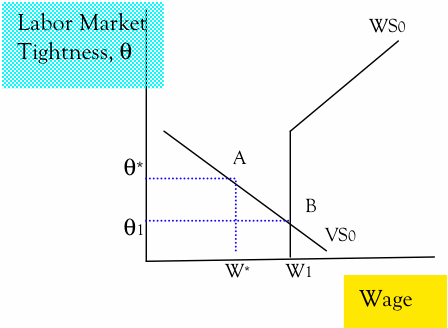
Assume that initially the wage-setting (WS0) and vacancy-supply (VS0) curves  intersect at point A determining both the equilibrium market wage w* and equilibrium labor market tightness, Î¸*. The job creation curve (whose slope is Î¸*) intersects our Beveridge curve at point A1 which determines that our equilibrium vacancy rate is V* and equilibrium unemployment rate is U*. These are represented graphically in Figure A.

Figure B: After a Mandated Increase in the Minimum Wage

Then out of the blue the government introduces a minimum wage w1 that exceeds the market wage w*.


The wage-setting curve now has a "floor" and this is represented by its vertical portion at the minimum wage.  As higher wages cut into business profits, firms open fewer vacancies. We move from point A to B in Figure B.   Since labor market tightness has now decreased from θ* to Î¸1, the job creation curve (with its new slope Î¸1) rotates downward.  The rotation of the job creation curve from JC0 to JC1 increases the unemployment rate from U* to U1. We moved from our original position at A1 to B1 and the job openings rate has decreased from V* to V1. In this situation a binding minimum wage raises both wages and unemployment. 

Incorporating Workers Job-Search Effort
Let's assume now that workers can choose the intensity with which they search for a job- how much time they spend searching the internet for a job, how many job applications they fill out, ect.  Under this assumption, a higher wage has two simultaneously opposing effects: 

a) A higher expected wage increases the payoff for workers when they finally do find a job. A worker with this in mind will be motivated to look harder and "more intensely." This increase in work intensity would shift our Beveridge curve inwards.
b) It weakens firms' incentives to create jobs because it cuts into their profit and thus making workers less likely to succeed and so depressing their search efforts.  Less intense search effort by the firm would correspond to an outward shift of the Beveridge curve.

        The net effect of these countering forces depends on where the wage stood before the increase.  To visualize this, consider two extreme cases where wages are initially really high or really low, depending on the extent of the workers bargaining power. First, suppose that workers are powerless and have no bargaining power, firms post wages unilaterally, and workers search until they find an acceptable wage offer.  Since employers appropriate the entire surplus from their relationship with labor, unemployed people have very little incentive to search actively for a job and the result is high unemployment.  Now consider the other extreme, where workers have all the bargaining power to set wages.  Firms make no profit from hiring more workers.  Since opening and advertising job vacancies is costly, firms rather not do so, and unemployment increases. 


Figure C: Increased Search Intensity by Workers


Markets that tend to be dominated by employers or equivalently where workers' bargaining power is pretty low, a compulsory increase in the wage can lead to higher search intensity and higher employment.  If the market wage is low, then a binding minimum wage can make employment more attractive to workers which strengthens their search efforts and reduces unemployment. Figure C graphs this result. The increase in workers search intensity would shift the Beveridge curve inward from BC0 to BC1 and the unemployment rate would go from U1 to U2, before the shift we were at point B1 and after the shift we settle at point C1.  In this respect the search model's results are consistent with the monopsony model as it explains how, in theory, a minimum wage can reduce unemployment.  If the the market wage is high, a binding minimum wage may discourage workers from looking for a job because there are fewer vacancies. It can also be shown that worker's search effort and social welfare move together.  The wage that maximizes search effort also maximizes social welfare. If the minimum wage is small enough, it can improve labor market conditions and increase social welfare.  
       Another interesting result of this model is that the minimum level of unemployment occurs when the market wage is below the one maximizes workers search effort.  This means that a minimum wage can make workers better off even if it increases unemployment.


Adding Labor Force Participation

If we focus our attention on the workers' decision to participate in the labor force we can use logic that mirrors that from our search intensity example.  If the market wage is very low because workers have little bargaining power, they might decide to not even look for a job at all.  They have no incentive to enter the market because non market activities, like home production and leisure, are more valuable than working and thus employment is low. Conversely if the market wage is very high, firms are not hiring, unemployment durations are long, and workers stay out of the labor force.  In general, employment is a hump-shaped function of the wage. However, unlike the model with workers' search effort, unemployment always decreases with the wage.  
         Although participation is weaker when wages are low, firms still create jobs because their profits are high.  This has the effect of swelling the number of vacancies relative to the number of job seekers, making it more probable that they will find employment.  If the market wage is too low and workers lack bargaining power, the introduction of a binding minimum wage strengthens labor force participation even though the duration of unemployment increases.  In contrast, if the market wage is high, a minimum wage reduces the supply of vacancies and increases unemployment duration, which has the balancing effect of discouraging workers from entering the labor force.      


Friday, April 15, 2011

The Modern Job Search and Matching Theory of Unemployment

Hello world,


I know that I haven't blogged in a while and that my fans are demanding some posts.  What I have decided to do is post this paper I have been working on all semester for my labor economics class. My underlying goal was to make something initially so abstract ( i.e. Modern Job Search and Matching Theory of Unemployment) seem intuitive and simple so that the general public can understand aspects of modern macroeconomics.


In order to achieve my goal I therefore encourage anyone who reads this to download the paper. The paper is on the Modern Job Search and Matching Theory of Unemployment which describes unemployment in terms of search and matching frictions.  I take the following from my abstract and introduction so that you get the general idea:


From Abstract:


This paper presents The Modern Search and Matching Theory of Unemployment in a manner that clears up most of the confusion surrounding it. The theory is broken up into sections analyzing the wage-setting curve, vacancy-supply curve, job creation curve and the Beveridge curve. Additionally, several major applications of the theory including the effects of search intensity, the minimum wage and unemployment compensation are reviewed. A look at the timing of movements in the unemployment rate during recessions is also provided. The hypothesis that labor demand is the main driving force behind the unemployment rate is tested and matching efficiency is also empirically estimated. The analysis concludes with an early search model and the appendix covers the mathematical form of the main model covered in the body of the paper.


From Introduction:


Among academics and professional economists alike the modern job search and matching theory of unemployment has become the industry wide norm for analyzing fluctuation and movements within the labor market. The contribution it has made to modern macroeconomics is revolutionary and its implications will take years to fully comprehend and appreciate. Standing at the forefront of modern macroeconomic research it has already received much praise as witnessed with the recognition of the theories founding fathers Christopher A. Pissarides, Peter A. Diamond and Dale T. Mortensen by The Royal Swedish Academy of Sciences.


Unfortunately, it is tendency of undergraduate economics departments to lag in teaching the revolutionary work of their graduate school counterparts. Even with the marvelous results and realistic nature of the modern search and matching theory of unemployment this time seems to be no different. Undergraduates everywhere are encouraged to analyze the labor market with neoclassical assumptions about market clearing, homogeneous agents and perfect information. Then they are told to peruse through the Bureau of Labor Statistics' Employment Situation only to observe the civilian unemployment rate persist around nine percent. A model as realistic as the modern job search and matching theory of unemployment has implications that are reinforced to students of economics by the news, while a model which calls for markets to always clear lacks that crucial element of believability. The time for a clear explanation must be without further delay. 


This paper seeks to explore the the modern job search and matching theory of unemployment by placing the Beveridge curve at the center of the analysis. Applications of the model will be brought to light. These include analyzing the effects of search intensity, the minimum wage, and unemployment insurance benefits on the unemployment rate. Additionally, a graphical analysis will be provided to shed light on why and when the unemployment rate moves during a recession. Using the Job Openings and Labor Turnover Survey and FRED, the hypothesis that labor demand drives movements in the unemployment rate during recessions is tested. 


Moreover, insights from behavioral economics are used to discuss some possible labor market policies that take advantage of this theory and individuals observed behavioral tendencies. Lastly an early and very microeconomic model of job search is brought to light to stress the importance of imperfect information in job search and the impacts of a workers reservation wage on their duration of unemployment.  


Friday, January 7, 2011

The Employment Situation

The employment situation is by far the most significant of all the major economic indicators.  The reasons include the data timeliness as it is literally released one week after the month being looked at and also the fact it includes data on household earnings and the job market which determines future spending.  

First thing to note is that the employment situation is broken up into two sections; the household survey and the establishment (or payroll) survey.  The household survey is essentially the government contacting 60,000 people each month, and from this data the civilian labor force along with how many of these people actually have jobs is calculated.  Furthermore, it is from the household survey that we derive the widely reported unemployment rate.  The establishment survey is considered to be a better employment measure than the household survey as its data comes directly from businesses, not households.  Each month the Bureau of Labor Statistics gets in touch with 400,000 companies and government agencies which are responsible for the employment of 40 million or so workers.  The following is a graph of total nonfarm payrolls (in thousands):
 One important thing to notice is the average number of hours worked in a week.  If the number of weekly hours increases for three consecutive months (aka the three month moving average is increasing), it is a strong signal that companies will soon accelerate hiring.  The same is true vice-versa, meaning if the three month moving average is declining then expect layoffs and cutbacks.  From the BLS employment situation report:
"The average workweek for all employees on private nonfarm payrolls
held at 34.3 hours in December. The manufacturing workweek for all
employees declined by 0.1 hour to 40.2 hours, while factory overtime
remained at 3.1 hours."
As the following graph shows average weekly hours have remained steady, indicating the economy is not going to be doing much on the hiring front:

Overtime hours are noteworthy because in times of economic uncertainty, rather than hiring new workers companies might ask their employees to work additional hours.  The catch is that overtime hours can be costly for a firm and so if there is a consistent upward trend in hours for 3 months firms are put under pressure to hire again. Changes in overtime manufacturing hours are considered particularly sensitive to fluctuations in demand. As the following graph shows over time hours have indeed increased but are still below pre-recessionary levels:

One of the best things to look at when seeking to reveal trends in future employment is temporary employment.  Companies often prefer to employ temporary help, due to lingering uncertainty I suppose, before taking the big daddy all in expensive step of permanently hiring and training new full-time employees.  Temps are cheaper and they give firms flexibility to add and reduce staff during these most certainly uncertain times.  The following graph paints the picture that firms are adding temps, but we have some time yet to see if this translates into any permanent hiring.
The source for the graph above is indeed the BLS and the data was extracted from the best site ever created- FRED.

The most recent employment situation reveals that the unemployment rate edged down to 9.4% and nonfarm payroll employment increased by a wompish 103,000 -considerably below expectations of around 150,000.  The drop from 9.8 to 9.4 in December, on the surface seems pretty great, however it may just reflect people leaving the labor force because they no longer receive unemployment benefits and consider themselves hopeless.  The WSJ real time economics blog highlights this change:
"The big drop in the overall unemployment rate and the U-6 measure was primarily due to a decline in the number of unemployed, which fell by 556,000 in December. That’s good news since the number of people who are employed increased by nearly 300,000. But that still leaves over 250,000 workers leaving the labor force altogether. That likely means a substantial part of the drop was due to workers giving up. Anyone unemployed over 99 weeks has no access to unemployment benefits and many lose access even earlier. Once those benefits expire, the unemployed may stop considering themselves part of the labor force."
Sudeep Reddy of the Wall Street Journal's Real Time Economics Blog makes at least one other interesting point claiming that at this pace we will have to wait until the 2020's before the unemployment rate hits 5% again:
"The economy lost almost 8.4 million jobs from December 2007 to December 2009. It added 1.1 million jobs in 2010. At December’s pace, just replacing the rest of those lost jobs would take 70 more months — roughly six years, taking us to November 2016...But the economy also needs to add 100,000 to 125,000 jobs a month just to keep pace with growth in the labor force... Even employment gains close to October’s pace (210,000 jobs) would take us into the next decade before seeing the unemployment rate back near 5%."
That's a bummer.  For considerably more analysis on the employment situation please read the Wall Street Journals Real Time Economics Blog. 

Tuesday, June 8, 2010

Index of Small Business Optimism and the Aggregate Demand Dilemma

The National Federation of Independent Business Index of Small Business Optimism increased 1.6 points in May with a reading of 92.2. The analysis states that although this is not a strong sign of recovery, it is nevertheless headed in the right direction. It is recorded as the best reading since September 2008. A look inside the report reveals that only one percent of small business owners plan on increasing employment, but this is still better than in April. An important insight into how this recessions recovery compares (lags behind) to those of the past:
"Since the third quarter of 2009, job creation plans have seriously underperformed the recoveries from the other two deep recessions covered by the NFIB survey. Coming out of the milder 1991 recession, construction added more than 100,000 jobs and 20,000 new firms in a year's time."
Credit conditions are of special interest in the report and point to very slow improvement. A net 13 percent of NFIB members reported loans harder to get than in their last attempt, which is down one point from April. The main reason for small businesses owners not hiring or expanding their business is because of the lack in aggregate demand as ninety-two percent of the owners reported all their credit needs met, or they did not want to borrow.
"Very weak plans to make capital expenditures, to add to inventory and to expand operations make it clear that many good borrowers are simply on the sidelines, waiting for a good reason to make capital outlays and order inventory and take out the usual loans used to support these activities."
The report makes the claim that what businesses need are customers, giving them a reason to hire and make capital expenditures and borrow to support those activities. Indeed, thirty percent cited weak sales as their top business problem, which is up one point from April.