What does an increase in counterparty risk even mean? It means that banks become more reluctant to lend to other banks because of the perception that the risk of default on their loans has increased and/or the market price of taking on such risk has risen. The following three measures are said to reflect the current amount of counterparty risk.
Libor-Ois spread:
Overnight index swap (OIS) is composed As follows: at maturity, the parties exchange the difference between the interest that would be accrued from repeatedly rolling over an investment in the overnight market and the interest that would be accrued at the agreed OIS fixed rate. In contrast to Libor loans, OIS transactions involve little counterparty risk as no money changes hands until the maturity date. The difference in these two spreads is said to reflect counterparty risk and not liquidity factors.
Credit Default Swaps:
One measure of counterparty risk is the probability that banks might default on their debt. These probabilities can be assessed using the premiums on credit default swaps (CDS) which are like insurance policies for corporate bonds. the purchaser of a CDS pays a periodic fee to the seller in exchange for the promise of a payment, in the event of a bankruptcy or a default, of the difference between the par value and the market value of the corporate bond.
Libor-Repo spread:
This is the interest rate spread between unsecured and secured lending. The greater the risk of nonpayment of the loan the higher the spread should be. Repurchase Agreements(Repos) between banks are backed by Treasury Securities and are a form of secured lending.
Saturday, August 21, 2010


Monday, August 16, 2010
Everything But My Tuition Keeps Falling
A glance at the Empire State Manufacturing Survey reveals falling prices as the prices paid index shows disinflation and the prices received index hints at deflation:

The drop off in prices at the early production stages suggests that inflation will be lower down the line. A look at the Producer Price Index later this week, under the category "crude nonfood materials less energy" should reveal any deflationary cost pressures.
"Both price indexes declined. Continuing its downward trend for a third consecutive month, the prices paid index fell 5 points to 20.0, suggesting that the pace of input price increases slowed. The prices received index, at -2.9, remained negative for a second consecutive month, a sign that selling prices were slightly lower in August."Additionally, the ISM manufacturing prices index is indicating a drop off in the rate of price increases:

The drop off in prices at the early production stages suggests that inflation will be lower down the line. A look at the Producer Price Index later this week, under the category "crude nonfood materials less energy" should reveal any deflationary cost pressures.
Sunday, August 15, 2010
A Look At TIPS Inflation Expectations
Here is the expected inflation. As stated before, (5 year nominal interest rate treasuries - 5 year TIPS) = expected inflation for next five years.

A look at the 5 year TIPS itself:

Is there possible deflation on the horizon?

A look at the 5 year TIPS itself:
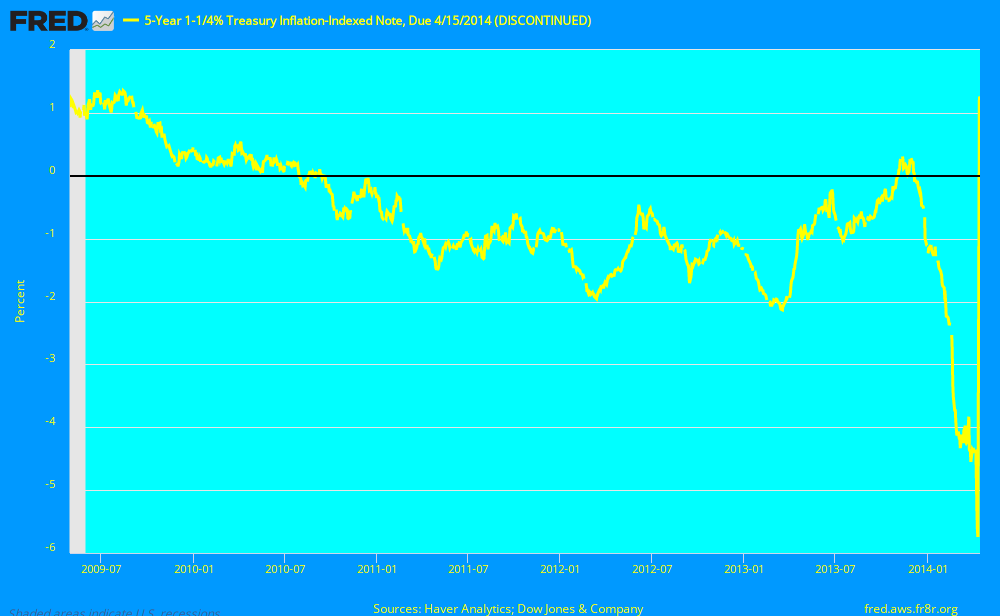
Is there possible deflation on the horizon?
Friday, August 13, 2010
David Rosenberg: Odds of Double-Dip Greater Than 50/50
Real time economics highlights an interview with David Rosenberg, Chief Economist at Canadian firm, Gluskin, Sheff & Associates:
Wednesday, August 11, 2010
Time to hold your breath
First of all closely watch this Friday's CPI (Consumer Price Index) index release, then closely follow other price index releases like the producer price index on the 17th. If the CPI trends to anything more "normal" then expected prepare to see a spike in U.S. treasury yields and a boom in stock prices. If the CPI stays the same or trends downward then bond yields will go lower as deflation would make the return on bonds -depending on how bad deflation got- attractive. In that case expect to see a significant decline in equities. The element that's hard to account for, the human element, will play a huge role. If investors get tired of the low treasury yields or if some happen to run hedge funds that promise wonderful returns, then there will be a greater incentive to take risks, and bond yields spike and the stock market rally.
Furthermore, depressing news from Europe like the recession in Greece worsening, any more bank failures and bailouts (Goldman Sachs perhaps?), and last but not least the Federal Government bailing out states that can't fulfill their debt obligations could also lead to treasury yields going lower. As one can see we are certainly in some rocky waters.
Furthermore, depressing news from Europe like the recession in Greece worsening, any more bank failures and bailouts (Goldman Sachs perhaps?), and last but not least the Federal Government bailing out states that can't fulfill their debt obligations could also lead to treasury yields going lower. As one can see we are certainly in some rocky waters.
Fed Challenge: A look at the competition and the experience
What the Chicago Fed does:
http://vimeo.com/8208920
Fed Challenge:
http://vimeo.com/5580423
Northwestern has won the Chicago Fed Challenge the past six years! The streak ends here if I have anything to say about it. A look at the competition:
http://www.northwestern.edu/newscenter/stories/2009/11/fed.html
Here is some basic information:
http://www.richmondfed.org/education/for_teachers/academic_competitions/college_fed_challenge/participants_resources/pdf/handbook.pdf
http://vimeo.com/8208920
Fed Challenge:
http://vimeo.com/5580423
Northwestern has won the Chicago Fed Challenge the past six years! The streak ends here if I have anything to say about it. A look at the competition:
http://www.northwestern.edu/newscenter/stories/2009/11/fed.html
Here is some basic information:
http://www.richmondfed.org/education/for_teachers/academic_competitions/college_fed_challenge/participants_resources/pdf/handbook.pdf
Imports, Exports and the Trade Balance
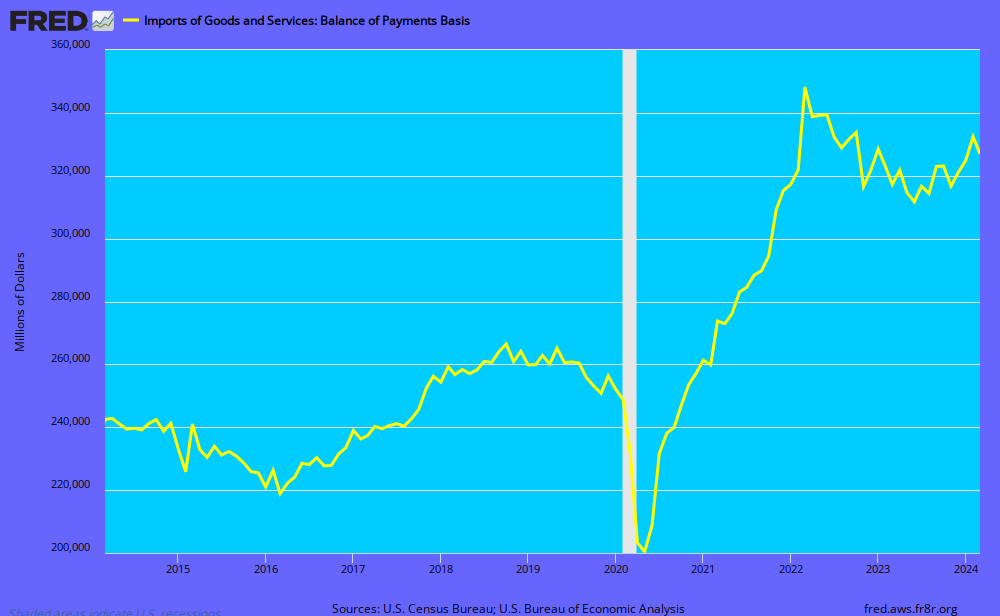
Rising imports are a sign that U.S. Consumers and Business are in fact demanding more. From the BEA report:
"June imports were $5.9 billion more than May imports of $194.4 billion."
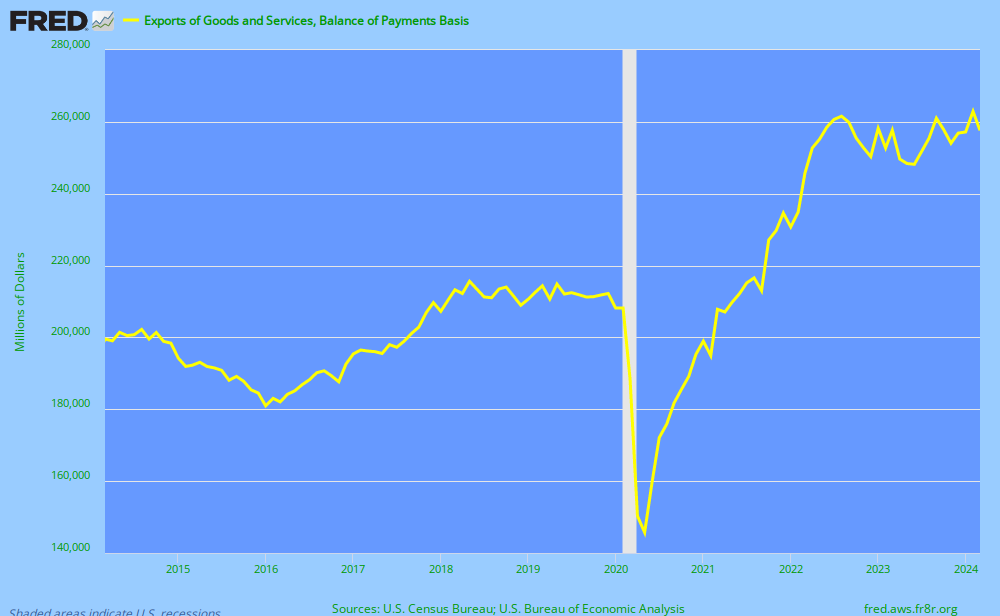
Meanwhile, U.S. Exports are also increasing but a slightly decreasing rate. The BEA stated today that:
"June exports were $2.0 billion less than May exports of $152.4 billion."From the graph it appears that global demand for U.S. goods and services has been turning up as well:
From the previous two graphs we get to look at a deteriorating trade balance (exports - imports):

Subscribe to:
Posts (Atom)