Showing posts with label Forcasting. Show all posts

Sunday, June 13, 2010

The Inventory to Sales Ratio and the Business Cycle

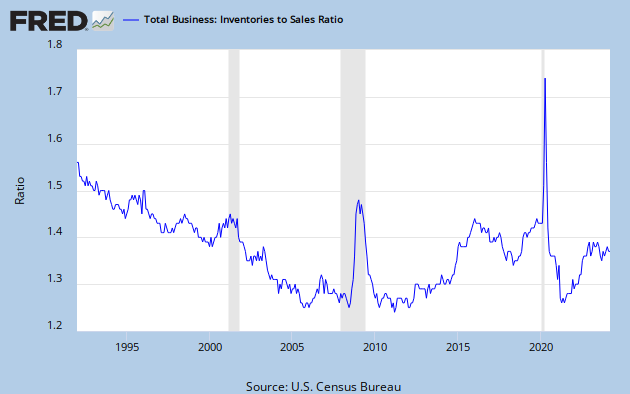
What is the Inventory-to-Sales Ratio and what can it tell us about where we are in the business cycle?  The inventory/sales ratio is put out every month in a report called the Manufacturing and Trade Inventories and Sales report by the United States Census Bureau and reflects the demand for goods by showing how sales are moving in relation to inventories.  Increasing sales relative to inventories is a positive sign because it means businesses are being outstripped by current demand.  A declining inventory/sales ratio is usually good news for the economy since it means that sales are increasing faster than inventories. Businesses respond to meet the increase in sales by speeding up orders and production rates. Therefore, a downturn in the inventory/sales ratio is a leading indicator that business conditions are improving and that interest rates are reaching cyclical troughs.

A rising inventory/sales ratio means that inventories are rising faster than sales.  In this scenario, businesses become overstocked and they respond to this unintended buildup of inventories by postponing orders and cutting production rates.  An upturn in the inventory/sales ratio is a leading indicator that business conditions are deteriorating and that short-term interest rates are approaching a cyclical peak.

So what are we seeing right now? Well the inventory/sales ratio has been decreasing which indicates that business conditions are indeed improving, but the inventory adjustment process may be over.  We are not going to see this contribution to GDP be as prolific as it has been in the recent past.  This has been highlighted by the blog Calculated Risk:
"It now appears the inventory adjustment is over.  Further growth in inventories will depend on increases in underlying demand."
The April report reveals that the ratio is 1.23 which means that it would take 1.23 months to completely clear inventories at the current level of sales.