This is not a positive sign as it will probably lead to a further drop in construction of new homes. 300,000 new homes were sold in May which is a 32.7% drop from April's numbers. For the Current Press Release. It is now estimated that it will take 8.5 months for all new homes to sell given current inventory and sales, this is a significant jump from last months 5.8 months. We have also seen a drop in the amount of homes for sale. One possible explanation: depressed housing values and demand has led to home builders waiting for current inventory to clear and demand to pick up. This is not good news for durable goods producers as it means depressed demand for all the things that usually go along with a new house.
Reactions to the data from WSJ can be found here.
Showing posts with label Economists React. Show all posts
Showing posts with label Economists React. Show all posts
Wednesday, June 23, 2010


Wednesday, June 16, 2010
Housing Starts Data: Not A Surprise
For X.U. Economics blog readers the drop in housing starts does not come as a surprise but is still discouraging. Yesterday we looked at the Housing Market Index which warned us that this would happen. Housing Starts and Building Permits data essentially just records the number of new homes being built and permits being issued for future construction.
When browsing over the data it is important to note the performance of "single-family housing start" as opposed to "multi-family starts." This is because single-family home building is based on consumer confidence and demand, while construction for multi-unit apartments can be subject to speculation and changes in the tax code. The most recent release indicates only 468,000 single-family housing starts in May as compared to the slight pick-up of 565,000 found in April's release ( Current New Residential Construction Press Release).
One possible explanation is the disappearance of the home-buyers tax credit and with it a vanishing act by demand. Another reasonable explanation is that growing families are looking to rent as opposed to purchasing a new home- especially with job stability being a hard thing to count on. Whatever the reason may be the drop in single family housing starts is not a good sign for those betting on a V-shaped recovery.
A look at Building Permits:
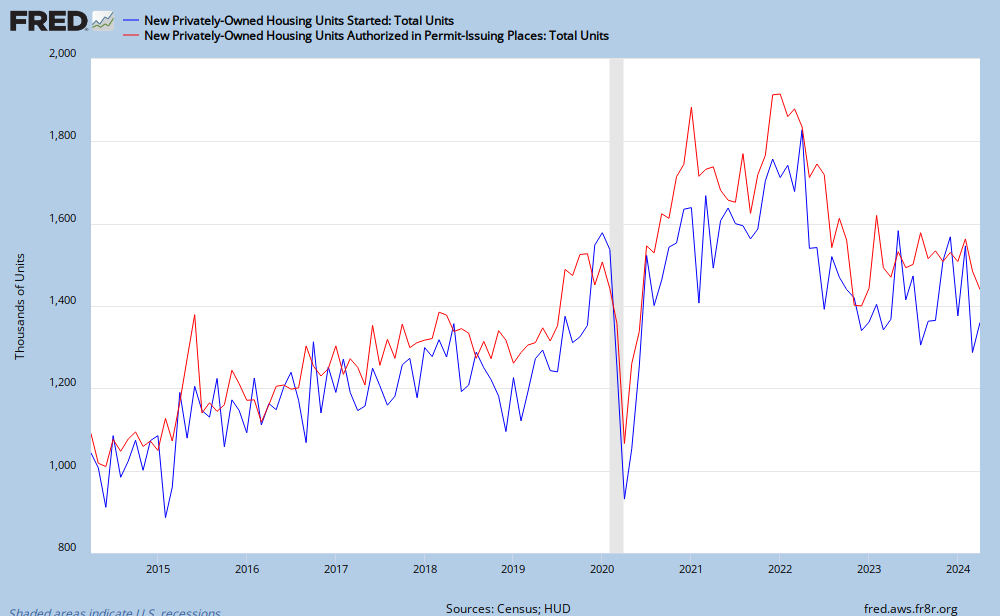
We have to keep close tabs on building permits because they are the precursor to housing starts. Although the issuance of a housing permit does not necessarily result in new construction, as you can see the two series do move together over time.
For other reactions to the housing start data.
When browsing over the data it is important to note the performance of "single-family housing start" as opposed to "multi-family starts." This is because single-family home building is based on consumer confidence and demand, while construction for multi-unit apartments can be subject to speculation and changes in the tax code. The most recent release indicates only 468,000 single-family housing starts in May as compared to the slight pick-up of 565,000 found in April's release ( Current New Residential Construction Press Release).
One possible explanation is the disappearance of the home-buyers tax credit and with it a vanishing act by demand. Another reasonable explanation is that growing families are looking to rent as opposed to purchasing a new home- especially with job stability being a hard thing to count on. Whatever the reason may be the drop in single family housing starts is not a good sign for those betting on a V-shaped recovery.
A look at Building Permits:
We have to keep close tabs on building permits because they are the precursor to housing starts. Although the issuance of a housing permit does not necessarily result in new construction, as you can see the two series do move together over time.
For other reactions to the housing start data.
Friday, June 11, 2010
A look at the Advanced Retail Sales Numbers
The U.S. Census puts out a report each month called the Advance Monthly Sales For Retail Trade and Food Services. Why should we as economists care about what this report says? I generally try to care about any report that the Fed deems important. So why does the Fed look at retail sales??? Retail Sales is used to compute Personal Consumption Expenditures, which is the most important component of calculating the nation's GDP. Changes in real GDP correlate well with changes in real retail sales.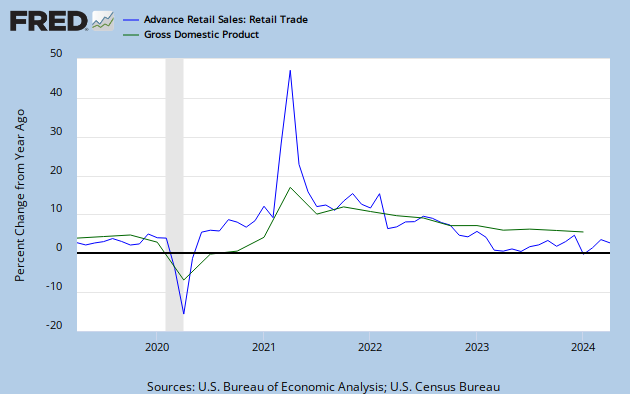
One thing to keep in mind is that retail sales is only measured in nominal terms, which means that no adjustment is made for inflation. This makes it difficult to tell whether a jump in the numbers came from consumers actually purchasing more or paying more to cover higher prices charged by retailers. Also the initial retail sales releases tend to be extremely volatile and thus misleading. This is partially because the advanced estimates are based on a relatively small sampling size. A three month moving average of the data provides a more accurate picture of whats occurring in the economy. For a look at the percentage changes go to table 2A which shows that retail sales dropped 1.4% in May but is still up 7.4% from last May. If you exclude motor vehicle sales and auto-related products (which tend to be extremely volatile) we see that the fall in the retail sales numbers is by a smaller 1.1% which (according to this number) is still up 6.1% from last May. So what exactly are U.S. consumers purchasing? Apparently gasoline which is up in usage 20.2% since last May (although this increase may represent an rise in gasoline prices). Furthermore, we see that the end of the April 30th homebuyer tax-credit brought about a drop in demand for building materials( -9.3% drop from last month). Overall the report is generally a disappointment among the economics community (check out WSJ's Economists React: 'Weaker Underlying Picture Revealed' for Consumer) as it suggests we have a struggling consumer. The Census Bureau should track polo hat sales: If demand for ridiculous items picks up then the "true American consumer" will be perched back up on their throne.
One thing to keep in mind is that retail sales is only measured in nominal terms, which means that no adjustment is made for inflation. This makes it difficult to tell whether a jump in the numbers came from consumers actually purchasing more or paying more to cover higher prices charged by retailers. Also the initial retail sales releases tend to be extremely volatile and thus misleading. This is partially because the advanced estimates are based on a relatively small sampling size. A three month moving average of the data provides a more accurate picture of whats occurring in the economy. For a look at the percentage changes go to table 2A which shows that retail sales dropped 1.4% in May but is still up 7.4% from last May. If you exclude motor vehicle sales and auto-related products (which tend to be extremely volatile) we see that the fall in the retail sales numbers is by a smaller 1.1% which (according to this number) is still up 6.1% from last May. So what exactly are U.S. consumers purchasing? Apparently gasoline which is up in usage 20.2% since last May (although this increase may represent an rise in gasoline prices). Furthermore, we see that the end of the April 30th homebuyer tax-credit brought about a drop in demand for building materials( -9.3% drop from last month). Overall the report is generally a disappointment among the economics community (check out WSJ's Economists React: 'Weaker Underlying Picture Revealed' for Consumer) as it suggests we have a struggling consumer. The Census Bureau should track polo hat sales: If demand for ridiculous items picks up then the "true American consumer" will be perched back up on their throne.
Subscribe to:
Posts (Atom)